IVF Treatment in Turkey: What It Is, How It Works, and the Stages
What Is IVF Treatment?
IVF treatment, medically known as in vitro fertilization (IVF),is one of the most advanced assisted reproductive techniques developed for couples who are unable to conceive naturally.
For international patients considering IVF treatment in Turkey, Assoc. Prof. Dr. Doğukan Özkan provides individualized assessment and treatment planning at his clinic in Ankara.

In IVF, eggs retrieved from the woman and sperm obtained from the man are brought together in a laboratory setting, and fertilization takes place under controlled conditions. The resulting embryo is then transferred into the uterus with the aim of achieving pregnancy.
This approach is far more than an imitation of the process that nature carries out on its own. IVF makes it possible to observe, select, and optimize critical stages such as fertilization and early embryo development. For this reason, it is not only a treatment method but also a technology that allows biological processes to be managed more effectively.
Who Is a Candidate for IVF Treatment?
IVF treatment is not the first option for every couple. However, in certain clinical situations, it stands out as the most effective and often the fastest solution. For this reason, when deciding on treatment, not only the “absence of pregnancy” but also the underlying causes of this situation should be taken into account.
Blocked fallopian tubes are one of the most classic indications for IVF treatment. In these patients, IVF is chosen directly because it is not possible for the sperm and egg to meet in their natural environment. Similarly, in cases of severe male infertility, pregnancy can be achieved by ensuring fertilization with the microinjection (ICSI) method.
Advanced maternal age is one of the most common indications for IVF today. As a woman ages, not only the number of eggs but also egg quality declines. This directly affects embryo development and the chance of pregnancy. Therefore, treatment planning should be carried out more quickly and effectively, especially after the age of 35.
IVF treatment also becomes an important option for patients with low ovarian reserve. Since lost time can further reduce the chance of pregnancy in these patients, the treatment process should not be delayed. However, the goal here is not simply to obtain more eggs, but to obtain the highest-quality embryo.
In patients with endometriosis, the situation can be more complex. This condition can affect both ovarian reserve and tubal function. It can also make it more difficult for the embryo to implant in the uterus. For this reason, IVF treatment plays an important role for many endometriosis patients.
In cases of unexplained infertility, pregnancy cannot be achieved even though all test results are normal. In these patients, treatment usually begins with simpler methods, but if no results are achieved within a certain period, IVF treatment is initiated. Making this transition at the right time is one of the most important factors determining the success of treatment.
Who Can Undergo IVF Treatment?
According to data from the World Health Organization (WHO) and the American Society for Reproductive Medicine (ASRM),IVF is an effective treatment option in conditions such as blocked tubes, severe sperm problems, ovulation disorders, endometriosis, diminished ovarian reserve, and unexplained infertility. It may also be used in cases of advanced maternal age, recurrent pregnancy loss, carrier status for genetic diseases, or for fertility preservation before cancer treatment.
Commonly known as a “laboratory-assisted method of conception for couples who cannot have children naturally,” IVF treatment is now widely chosen both out of medical necessity and for family planning purposes.
IVF treatment may be performed for:
- Couples who have not conceived despite one year of unprotected intercourse
- Patients with reduced egg quality due to advanced maternal age
- Women with blocked or damaged fallopian tubes
- Couples with severe male infertility and low sperm count
- Patients with endometriosis (chocolate cysts)
- Women with ovulation disorders or polycystic ovary syndrome (PCOS)
- Couples diagnosed with unexplained infertility
- Patients who have experienced recurrent miscarriages
- Couples who require embryo screening due to carrier status for a genetic disease
- Individuals who wish to preserve their fertility before cancer treatment
IVF Is One of the Most Effective Methods in Modern Reproductive Medicine!
When it was first developed, IVF treatment was used only in patients with blocked tubes; today, it is applied to a much broader group of patients. IVF has become an important option in many situations, such as male infertility, advanced maternal age, low ovarian reserve, endometriosis, and unexplained infertility. This wide range of applications clearly demonstrates the flexibility and effectiveness of the method.
The Key Difference Between Natural Conception and IVF
Conception is, in fact, a highly delicate biological scenario. In the natural process, the egg and sperm meet in the fallopian tubes, where fertilization takes place. The embryo then travels into the uterus and implants. However, a problem at any stage of this process can prevent pregnancy.
In IVF treatment, this process is brought under control. The ovaries are stimulated with medication to obtain multiple eggs, fertilization takes place in the laboratory, and the most suitable embryo among those that develop is selected and transferred. This offers a significant advantage, particularly for patients in whom natural fertilization is not possible or has a low chance of success.
From a clinical perspective, the greatest strength of IVF is “controllability.” This control enables more informed decisions both during fertilization and in embryo selection.
When Should IVF Treatment Be Considered?
The decision to start IVF treatment is one of the most critical points in infertility treatment. This decision should be made not only based on the current situation but also by considering future fertility potential. In young patients without a clear underlying problem, a more stepwise approach may be preferred. However, unnecessarily prolonging this process creates a serious disadvantage, especially in situations where time is critical. On the other hand, in patients of advanced age or with a clear cause of infertility, proceeding directly to IVF may be a more appropriate and rational approach.
One of the most common problems I encounter in my clinical practice is starting IVF treatment either earlier or later than necessary. Correct timing is just as important as the correct treatment. This is because success in infertility treatment is often achieved through “the right intervention at the right time.”
IVF Is Not Just a Treatment, It Is a Strategy!
IVF treatment is not only a technical procedure but also a strategic treatment approach. What does this mean? It cannot be applied in the same way to every patient and cannot be managed with a standard protocol. Success is made possible through patient-specific planning, correct timing, and experience-based clinical decisions.
For this reason, the IVF process does not consist solely of laboratory stages; it is a holistic treatment process that must be planned from start to finish.
How Is IVF Treatment Performed? The Stages
Although IVF treatment may appear from the outside to be a technical process consisting of specific stages, from a clinical perspective it requires highly dynamic and patient-specific planning. The fact that completely different results can be obtained even in two patients receiving the same treatment protocol clearly shows how individualized this process is.
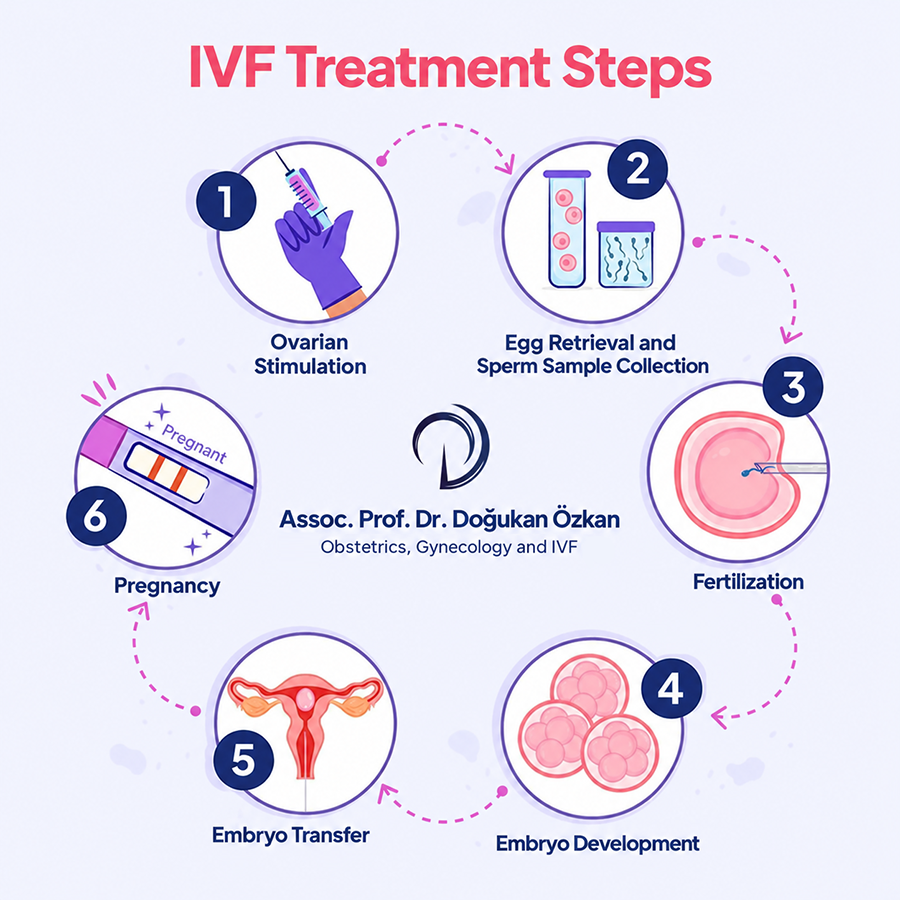
In general terms, IVF treatment begins with ovarian stimulation, followed by egg retrieval, fertilization in the laboratory, and transfer of the developing embryo into the uterus. However, behind this simple summary lie numerous critical details, each of which directly affects success.
The First Active Stage of the IVF Process
Ovarian Stimulation
The first stage of IVF treatment is controlled ovarian stimulation. While usually only one egg develops in a natural menstrual cycle, the aim in IVF treatment is to obtain multiple mature eggs. The main reason for this is to increase the chance of selection by obtaining more embryos (eggs fertilized with sperm).
The medications used in this process are determined according to the patient’s age, ovarian reserve, and previous treatment history. Because not every patient responds in the same way to the same medication dose, close monitoring of the treatment process is essential. For this reason, the ovarian response is evaluated through regular ultrasound examinations and hormone monitoring.
From a clinical perspective, the most important point at this stage is striking the right balance. Excessive stimulation can increase the risk of complications. Insufficient stimulation, on the other hand, may result in too few eggs being obtained. Therefore, dose adjustments made throughout the treatment process are among the critical decisions that directly affect success.
Egg Retrieval (OPU)
When the eggs reach a certain level of maturity, egg retrieval is scheduled. This procedure is usually performed under light anesthesia and with transvaginal ultrasound guidance. Using a fine needle, the fluid inside the follicles is aspirated, and the eggs contained in this fluid are transferred to the laboratory.
A Short but Critical Stage
Although the procedure is brief, this stage is one of the most important turning points of the treatment. The number and quality of the eggs retrieved directly affect embryo development and therefore the chance of pregnancy. However, what matters here is not just the number; biological quality is often more decisive than numerical success.
My clinical experience shows that obtaining a large number of eggs does not always mean a better outcome. For this reason, the treatment approach should aim not to obtain the maximum possible number of eggs, but to obtain the best-quality embryo.
The Fertilization Process
The retrieved eggs are fertilized with sperm in the laboratory on the same day. Today, the most commonly used method is microinjection, or ICSI. In this method, a single sperm selected by the embryologist is injected directly into the egg.
This technique significantly increases success, particularly in cases of male infertility. However, it may be preferred not only for male factor infertility but also in many other clinical scenarios. Whether fertilization has occurred is checked the following day, and successfully fertilized eggs are monitored for embryo development.
The Role of the Laboratory
This is the stage at which treatment depends most on laboratory quality. The technical infrastructure and experience of the embryology laboratory directly affect the success of this process.
Embryo Development
The fertilized eggs become embryos and develop for several days in special culture environments in the laboratory. During this period, the embryos’ cell count, division pattern, and morphological characteristics are carefully monitored.
Embryos are usually cultured until day 3 or day 5. Day-5 embryos, or blastocysts, are often preferred because they have a higher implantation potential. However, not every embryo is expected to reach this stage, and this is entirely a process of biological selection — in other words, a reflection of natural selection in the laboratory.
Embryo development is not only a technical process but also an opportunity to observe nature’s own selection mechanism in a laboratory setting. For this reason, the data obtained at this stage also provide important information for future treatment planning. It increases our understanding of the patient’s individual characteristics and informs any changes to treatment.
Embryo Transfer
The Most Delicate Point of the Process
Embryo transfer is a stage that appears technically simple but is clinically highly delicate. The selected embryo is placed into the uterus using a thin catheter. The procedure is usually painless and does not require anesthesia.
The most important point at this stage is transferring the right embryo at the right time. An endometrium (the inner lining of the uterus) of appropriate thickness and structure increases the embryo’s chance of implantation. For this reason, the timing of the transfer is determined not only by embryo development but also by uterine preparation.
From a clinical perspective, the success of the transfer depends not only on embryo quality but also on technique and timing.
The Post-Transfer Period
The period that begins after embryo transfer is one of the most challenging phases for patients. During this time, progesterone support is usually given to support embryo implantation. However, there is a great deal of misinformation in society about how this period should be managed.
The belief that complete bed rest is necessary after transfer is not correct. In fact, excessive rest should be avoided. Continuing daily life in a controlled manner is generally sufficient. The most important factors during this period are taking medications regularly and reducing unnecessary stress.
The process is not simple... but it is manageable.
Although IVF treatment may appear to be a process consisting of specific stages, each step involves its own delicate balances. For this reason, success depends not only on carrying out these stages but also on managing them correctly.
Each stage forms the foundation for the next, and a problem in any link of this chain can affect the overall outcome. For this reason, IVF treatment is as much a strategic process as it is a technical one.
What Does the IVF Success Rate Mean, and How Should It Be Interpreted?
When it comes to IVF treatment, success rates are among the topics patients are most curious about. However, understanding these rates correctly is extremely important for approaching treatment with a realistic perspective. This is because success in IVF is not a simple concept that can be expressed as a single percentage; rather, it is a dynamic outcome resulting from the combination of many variables.
A Realistic Assessment Should Be Provided
In the clinical literature, success is usually defined as the “pregnancy rate per transfer” or the “live birth rate.” However, these rates are not independent of patient characteristics. The fact that results can differ even between two treatments performed at the same center using the same techniques shows how individualized infertility management is. Therefore, while general statistics can serve as a guide, individual success predictions should always be evaluated separately.
Female Age: The Most Decisive Factor in IVF Treatment
The most important factor affecting success in IVF treatment is the woman’s age. With increasing age, not only the number of eggs but also egg quality declines. This directly affects embryo development and the continuation of pregnancy.
While embryos obtained in younger age groups are more likely to be genetically healthy, the risk of chromosomal abnormalities rises significantly with advancing age. This can prevent the embryo from implanting in the uterus or lead to early pregnancy loss, even if fertilization occurs.
Clinically, the age factor determines not only the success rate but also the treatment strategy. For this reason, age is always one of the first parameters to be evaluated in infertility management.
The Difference Between Ovarian Reserve and Egg Quality
Ovarian reserve is a parameter that is frequently emphasized in IVF treatment. However, there is an important distinction here: reserve and quality are not the same thing. A patient with low reserve may still produce good-quality eggs, while in a patient with high reserve, embryo quality may be lower than expected. Egg quality can also be thought of as the egg’s ability to be fertilized.
AMH level and antral follicle count provide information about ovarian reserve but do not directly indicate embryo quality. Therefore, predicting success based solely on laboratory figures or numerical values can be misleading. The clinical approach requires evaluating these parameters together for a more realistic analysis.
Especially in patients with low reserve, the goal of treatment is not to obtain the maximum number of eggs, but to make the best use of the existing potential to obtain good-quality embryos.
Why Is Embryo Quality So Important?
In IVF treatment, embryo quality is one of the most critical factors determining success. Embryos developing in the laboratory are evaluated according to their cell count, division pattern, and morphological characteristics. Based on this evaluation, the embryos with the highest implantation potential are selected.
(Implantation: the attachment of the embryo to the inner lining of the uterus.)
Embryos are usually transferred at the day-3 or day-5 stage. Day-5 embryos, or blastocysts, are generally associated with higher pregnancy rates because they are at a more advanced stage of development. However, not every embryo can reach this stage, and this is entirely a process of biological selection. It is influenced by individual differences, and both the egg from the woman and the sperm from the man play a role in reaching this stage.
Embryo evaluation is not limited to microscopic appearance alone. The patient’s age, clinical history, and previous treatment results are also an important part of this process. For this reason, embryo selection is a decision point where laboratory data and clinical experience come together.
The Impact of Sperm Quality
Although the focus in IVF treatment is often on the female factor, sperm quality is also an important parameter that directly affects embryo development. In addition to sperm count, motility, and morphology, DNA integrity also plays a role in this process.
Although the microinjection (ICSI) method increases the chance of fertilization in patients with severe male infertility, it does not completely eliminate the effect of sperm quality on embryo development. For this reason, correctly evaluating the male factor is critically important for treatment success.
The Uterine and Endometrial Factor
For successful IVF treatment, a suitable uterine environment is just as necessary as a good-quality embryo. For the embryo to implant in the uterus, the endometrium must have a certain thickness and structure.
In some patients, the reason pregnancy cannot be achieved despite good embryo quality may be intrauterine factors. In such cases, the uterine evaluation should be more detailed and, if necessary, the treatment plan should be revised accordingly. Of course, this cannot be measured solely by the thickness of the endometrium (the inner lining of the uterus). Just as it would be wrong to say that pregnancy can never occur with an endometrium that has not reached the desired thickness, it would also be wrong to say that pregnancy will always occur with an endometrium that has reached the desired thickness.
Why Does IVF Success Vary From Person to Person?
There are many factors that affect success in IVF treatment, and the combination of these factors is different in every patient. For this reason, different results can be obtained even in two patients receiving the same treatment.
Many variables affect this process, including age, egg quality, sperm status, embryo development, uterine factors, and even lifestyle. This clearly shows why infertility treatment is not a standard procedure.
The Most Important Clinical Approach: “Setting Realistic Expectations”
One of the most important goals in my clinical practice is to give patients realistic expectations of success. Although IVF is a method with high success rates, it never guarantees a definite outcome.
Understanding this process correctly helps patients be better prepared psychologically and increases adherence to treatment. In particular, not achieving pregnancy on the first attempt does not mean that the treatment has failed. Each attempt provides important information for the next treatment.
Success in IVF Treatment Is a Matter of Balance!
Success in IVF treatment cannot be explained by a single factor. This process requires the balanced management of many biological and clinical variables. Correct patient selection, the right treatment plan, and an experienced clinical approach form the foundation of this balance.
For this reason, the most effective way to increase success is to evaluate the process from a holistic perspective and to develop a patient-specific strategy for every patient.
Which IVF Treatment Is Right for Whom?
The method to be used in IVF treatment should be determined individually according to the woman’s age, ovarian reserve, the man’s sperm quality, the duration of infertility, and any underlying health problems. According to current international guidelines, different treatment protocols such as conventional IVF, microinjection (ICSI),IVF with genetic testing (PGT),frozen embryo transfer (FET),or minimal stimulation are planned according to each patient’s biological needs.
For example, microinjection is preferred in severe male infertility, while genetic screening of embryos may be performed in cases of advanced maternal age or a history of recurrent miscarriage. This approach — which can be summarized as “not every patient receives the same IVF treatment” — aims to increase success rates while reducing unnecessary medication use and wasted treatment cycles.
- Couples with severe sperm problems → Microinjection (ICSI)
- Couples who are carriers of a genetic disease → PGT-assisted IVF treatment
- Advanced maternal age → Individualized IVF protocols focused on embryo quality
- Women with low ovarian reserve → Minimal stimulation or specialized ovarian stimulation protocols
- Patients with polycystic ovary syndrome (PCOS) → Controlled low-dose ovulation induction treatments
- Recurrent IVF failure → FET protocols focused on embryo freezing and endometrial preparation
- Women with blocked tubes → Conventional IVF or ICSI
- Unexplained infertility → IVF planning based on age and duration of infertility
- Before cancer treatment → Egg or embryo freezing
- Patients with intrauterine problems → Hysteroscopic evaluation first, followed by IVF treatment
Is IVF Treatment Applied the Same Way for Everyone?
Although IVF treatment is often perceived as a single method, clinical practice clearly shows that this does not reflect reality. IVF treatment is, in fact, a dynamic and highly individualized treatment strategy shaped according to different patient groups. Applying the same protocol to every patient can often limit success rather than increase it.
For this reason, the approach in modern reproductive medicine is built on the concept of “personalized treatment” rather than a “standard protocol.” Many factors — including the patient’s age, ovarian reserve, cause of infertility, response to previous treatments, and even lifestyle — directly affect the treatment plan.
The IVF Decision in Young Patients
Deciding on IVF treatment in younger patients often requires a careful balance. Because these patients still have the potential for natural conception, it is not necessary to proceed directly to IVF in every case. A more stepwise approach may be preferred, especially in couples with a short duration of infertility and no identifiable pathology.
However, the critical point here is that this process should not be unnecessarily prolonged. One of the most common clinical mistakes is continuing the “young patient, let’s wait” approach without control. In other words, just as being hasty can be wrong, being too relaxed and extending the waiting period can also reduce the chance of success over time.
For this reason, the approach in young patients should be patient but controlled. If pregnancy is not achieved within a certain period, the treatment plan should be reassessed.
IVF at Advanced Maternal Age: “A Race Against Time”
As a woman’s age advances, the IVF decision-making process changes significantly. Particularly after the age of 35, the decline in egg quality becomes central to the treatment strategy. At this point, time becomes the most critical factor.
In my clinical practice, I often adopt a faster and more direct approach in patients aged 38 and over. In this patient group, intermediate steps such as intrauterine insemination often provide limited benefit and can lead to lost time. For this reason, proceeding directly to IVF treatment may be a more rational approach.
We know that there is a dramatic decline in egg quality and quantity after the age of 40. At this point, it is also important to give the patient a realistic framework. Clearly stating that success rates decrease with age allows the treatment process to begin on a healthier footing.
Low Ovarian Reserve in IVF
Patients with low ovarian reserve form a special group in IVF treatment. The most common mistake in these patients is trying to obtain more eggs with high-dose medications. However, clinical data show that this approach does not always produce better results.
In this patient group, the main goal is to obtain good-quality embryos by using the existing reserve as efficiently as possible. For this reason, the treatment plan should be more precise and individualized.
The time factor is also critically important in these patients. Unnecessary delays can further reduce the existing potential.
IVF in Male Infertility
In cases of infertility due to the male factor, the treatment approach is usually more clear-cut. If there are significant abnormalities in sperm parameters, IVF — and particularly the microinjection (ICSI) method — is chosen directly.
In some cases, even when the sperm count is extremely low, pregnancy can be achieved thanks to laboratory techniques. For this reason, proceeding to IVF without losing time is the most effective approach in severe male infertility.
However, here too, it is important to pay attention not only to sperm count but also to sperm quality and DNA integrity.
Endometriosis and IVF
Surgery or Direct Treatment?
The IVF decision in endometriosis patients is one of the most complex clinical scenarios. This condition can affect ovarian reserve and can also cause structural changes around the tubes and uterus.
For this reason, it is not appropriate to apply the same approach to every endometriosis patient. In some patients, the chance of success can be increased with surgical treatment, while in others, proceeding directly to IVF may be more advantageous.
This decision should be made by evaluating the patient’s age, the severity of the disease, and the duration of infertility together.
Unexplained Infertility: When Should IVF Be Considered?
Unexplained infertility is one of the most frequently encountered yet most difficult situations to manage in clinical practice. In these patients, simpler treatments such as intrauterine insemination may be tried initially.
However, if pregnancy is not achieved after a certain number of attempts, the transition to IVF should not be delayed. At this point, the most important decision is “when to make the transition.” Unnecessarily prolonged treatment steps can reduce the chance of success, especially in patients for whom age is a factor.
There Is No Single Path
In real clinical practice, the IVF decision is made not with a fixed algorithm but through patient-specific evaluation. In this process, age, duration of infertility, biological reserve, and the underlying cause are evaluated together.
When creating a treatment plan in my clinical practice, one of the most important questions is: “For this patient, is time more critical, or is there room to wait?” The answer to this question determines the direction of the treatment strategy.
IVF treatment is not only a technical procedure but also a decision-making process that must be applied to the right patient at the right time. In this process, individualization is the most important factor determining success.
Creating a different roadmap for every patient forms the basis of modern infertility management. This approach not only increases success rates but also strengthens the patient’s trust in the treatment process.
Common Misconceptions About IVF Treatment and the Clinical Facts
Why Is There So Much Misinformation About IVF?
IVF treatment is one of the most widely discussed medical topics, both in the media and in social circles. This intense interest also brings with it a great deal of misinformation. In particular, superficial or misinterpreted information on the internet can directly affect patients’ perception of the treatment process.
In clinical practice, a significant proportion of patients come to us with strong preconceptions or incorrect expectations before starting treatment. This not only makes the process harder to understand but can also negatively affect adherence to treatment. For this reason, separating accurate information from inaccurate information is one of the most critical steps in the treatment process.
The Misconception That IVF Always Works
One of the most common misconceptions is the belief that IVF treatment always produces a definite result. In reality, although IVF has a high success rate, it never offers a guarantee. This is because the treatment, by its nature, depends on biological variables. Success is determined by the combination of many parameters, such as age, number of embryos, embryo quality, the uterine environment, sperm quality, sperm count, and genetic factors. For this reason, starting treatment with realistic expectations helps the process be managed in a psychologically healthier way.
The Perception That “More Embryos Mean Higher Chances”
Another widespread belief is that the number of embryos is directly proportional to success. However, clinical reality shows that this is not always the case. Obtaining a large number of embryos can be an advantage, but the decisive factor is embryo quality.
A single high-quality embryo, especially one whose genetic status is known, may have a higher pregnancy potential than many low-quality embryos. For this reason, the goal during treatment is not to increase numbers but to optimize quality.
The Belief That “You Must Stay in Bed After the Transfer”
One of the most common misconceptions in the period after embryo transfer is that the patient must remain inactive for a long time. However, this approach has no scientific basis. Continuing normal daily activities in a controlled manner after the transfer is generally sufficient.
An overly restrictive approach provides no physical benefit and may increase psychological stress levels. For this reason, patients should be advised to maintain a balanced lifestyle.
The Idea That “Stress Prevents Pregnancy”
The effect of stress on infertility is often exaggerated. It is known that chronic stress and chronic sleep deprivation can make adherence to treatment more difficult and may have indirect effects.
For this reason, it is sufficient to recognize the additional stress the process may create and the anxiety the patient may bring with them, and to manage this from the very beginning of the process.
The Perception That “If the First Attempt Fails, the Chances Drop”
Many patients perceive not achieving pregnancy on the first IVF attempt as a failure. However, from a clinical perspective, this is quite common and is a natural part of the treatment process.
Each attempt provides important data for the next treatment. The treatment plan can be optimized by analyzing factors such as embryo development, the laboratory process, and the uterine response. For this reason, the IVF process is not a single attempt but a process that is developed step by step.
Every attempt is a new chance. The most important thing to do after an unsuccessful attempt is to try again without losing hope.
The Misconception That “Every Patient Receives the Same Treatment”
The idea that IVF treatment is carried out with a standard protocol is also an important misconception. In reality, modern infertility management requires a fully individualized approach.
Different treatment strategies may be applied even in two patients of the same age with similar diagnoses. For this reason, the treatment plan should be created by taking all of the patient’s clinical characteristics into account.
A Realistic and Individual Roadmap
One of the most important goals in my clinical practice is to offer patients an accurate and balanced perspective. IVF treatment is a hopeful method, but this hope should be presented within a realistic framework. It should not be approached with a promotional mindset.
Clearly explaining all stages of the process, especially before starting treatment, increases the patient’s adherence to treatment. In addition, it should be emphasized that every unsuccessful attempt provides valuable data for the next step.
With experience, correct planning, and correct timing, the success rate of IVF treatment can be significantly increased. However, the most important factor in this process is adopting a patient-specific approach.
One of the most important elements in increasing success in IVF treatment is access to accurate information. Misconceptions can lead to both unnecessary anxiety and incorrect expectations. For this reason, the treatment process should be managed in light of scientific data and clinical experience.
A treatment process that begins with accurate information progresses more smoothly and has a higher potential for success.
Frequently Asked Questions About IVF Treatment
The Most Common Questions About the IVF Process
IVF treatment is, by its nature, a process involving many uncertainties and is intense and challenging for couples both physically and psychologically. For this reason, it is entirely natural for patients to have many questions. In clinical practice, most of these questions turn out to be similar. This section aims to provide scientifically and clinically grounded yet easy-to-understand answers to the most frequently asked questions.
How Long Does IVF Treatment Take?
IVF treatment usually covers a period of approximately two to three weeks from the start of the menstrual cycle. Beginning with ovarian stimulation, the process continues with egg retrieval, fertilization, and embryo transfer. However, because the protocol applied differs for each patient, the duration may vary individually.
Is the IVF Treatment Process Painful?
Contrary to what most patients think, IVF treatment is a quite tolerable process. The daily injections usually cause minimal discomfort. Since egg retrieval is performed under anesthesia, no pain is felt. The transfer procedure is also painless.
Can Success Be Achieved on the First IVF Attempt?
Pregnancy can be achieved on the first attempt. It is possible, but it is not guaranteed for every patient. The success rate varies depending on age, embryo quality, and the underlying cause of infertility. Clinically, it is common for success to be achieved after more than one attempt.
How Many Times Can IVF Be Attempted?
There is no fixed limit on the number of IVF attempts. However, it is important to analyze the process after each attempt and to modify the treatment plan when necessary. The aim is to increase the chance of success with each new attempt.
What Should Be Considered After Embryo Transfer?
An overly restrictive lifestyle is not recommended after the transfer. Daily life can be continued in a controlled manner. However, it is important to avoid strenuous physical activity, to take medications regularly, and to reduce stress as much as possible. You should stay in constant communication with your doctor and nurse.
Is There a Risk of Twin Pregnancy With IVF Treatment?
If more than one embryo is transferred, the risk of multiple pregnancy may increase. Today, single embryo transfer is preferred in most patients to reduce this risk. This approach is considered safer for both mother and baby.
What Affects IVF Success the Most?
The most important factor affecting IVF success is the woman’s age. In addition, embryo quality, sperm characteristics, and the internal environment of the uterus also play an important role. For this reason, the treatment process should be planned by evaluating all of these factors together.
Does IVF Reduce the Chance of Natural Pregnancy?
IVF treatment does not reduce the chance of natural pregnancy. In fact, spontaneous pregnancy may be observed in some patients after treatment. This reflects the dynamic and variable nature of infertility.
What Happens If IVF Doesn’t Work?
When treatment is unsuccessful, the process is analyzed in detail. Embryo quality, uterine factors, and the protocol used are re-evaluated. Based on this analysis, a new treatment plan is created. This approach increases the chance of success in the next attempt, and a new attempt is then made.
IVF Treatment Appointment
IVF treatment is a multi-layered process that must be planned from start to finish. Success depends not only on technical procedures but also on correct patient selection, correct timing, and an individualized treatment approach.
One of the most important goals in my clinical practice is to create a patient-specific roadmap and to manage the process in as simple and understandable a way as possible. This is because a well-informed patient adapts better to the treatment process, and this directly affects success.
Although IVF treatment is one of the most effective assisted reproductive methods in modern medicine, it requires a different strategy for every patient. For this reason, it is very important to carry out a detailed evaluation and create a personalized plan before starting treatment.
If you are considering IVF treatment in Turkey and would like detailed information or an evaluation tailored to your situation, you can contact our clinic in Ankara so that we can plan the process together.
References
- Centers for Disease Control and Prevention. 2022 Assisted Reproductive Technology Fertility Clinic and National Summary Report. CDC; 2024.
- Zegers-Hochschild F, Adamson GD, Dyer S, et al. The International Glossary on Infertility and Fertility Care, 2017. Human Reproduction. 2017;32(9):1786–1801.
- ESHRE Guideline Group on Ovarian Stimulation. ESHRE guideline: ovarian stimulation for IVF/ICSI. Human Reproduction Open. 2020;2020(2):hoaa009.
- Practice Committee of the American Society for Reproductive Medicine. Performing the embryo transfer: a guideline. Fertility and Sterility. 2017;107(4):882–896.
- McLernon DJ, Maheshwari A, Lee AJ, Bhattacharya S. Cumulative live birth rates after one or more complete cycles of IVF: a population-based study of linked cycle data from 178,898 women. Human Reproduction. 2016;31(3):572–581.
- Glujovsky D, Farquhar C, Quinteiro Retamar AM, et al. Cleavage-stage versus blastocyst-stage embryo transfer in assisted reproductive technology. Cochrane Database of Systematic Reviews. 2016;(6):CD002118.
- Van der Linden M, Buckingham K, Farquhar C, Kremer JAM, Metwally M. Luteal phase support for assisted reproduction cycles. Cochrane Database of Systematic Reviews. 2015;(7):CD009154.
- Sunkara SK, Rittenberg V, Raine-Fenning N, Bhattacharya S, Zamora J, Coomarasamy A. Association between the number of eggs and live birth in IVF treatment: an analysis of 400,135 treatment cycles. Human Reproduction. 2011;26(7):1768–1774.
- La Marca A, Sunkara SK. Individualization of controlled ovarian stimulation in IVF using ovarian reserve markers: from theory to practice. Human Reproduction Update. 2014;20(1):124–140.
- Alpha Scientists in Reproductive Medicine and ESHRE Special Interest Group of Embryology. The Istanbul consensus workshop on embryo assessment: proceedings of an expert meeting. Human Reproduction. 2011;26(6):1270–1283.
- Esteves SC, Roque M, Bedoschi G, Haahr T, Humaidan P. Intracytoplasmic sperm injection for male infertility and consequences for offspring. Nature Reviews Urology. 2018;15(9):535–562.
- Kasius A, Smit JG, Torrance HL, et al. Endometrial thickness and pregnancy rates after IVF: a systematic review and meta-analysis. Human Reproduction Update. 2014;20(4):530–541.
- Legro RS, Brzyski RG, Diamond MP, et al. Letrozole versus clomiphene for infertility in the polycystic ovary syndrome. New England Journal of Medicine. 2014;371(2):119–129.
- Homan GF, Davies M, Norman RJ. The impact of lifestyle factors on reproductive performance in the general population and those undergoing infertility treatment: a review. Human Reproduction Update. 2007;13(3):209–223.
- Rooney KL, Domar AD. The relationship between stress and infertility. Dialogues in Clinical Neuroscience. 2018;20(1):41–47.
- Sharma R, Biedenharn KR, Fedor JM, Agarwal A. Lifestyle factors and reproductive health: taking control of your fertility. Reproductive Biology and Endocrinology. 2013;11:66.
- Johnson NP, Hummelshoj L; World Endometriosis Society Montpellier Consortium. Consensus on current management of endometriosis. Human Reproduction. 2013;28(6):1552–1568.
- Pandian Z, Gibreel A, Bhattacharya S. In vitro fertilisation for unexplained subfertility. Cochrane Database of Systematic Reviews. 2015;(11):CD003357.